
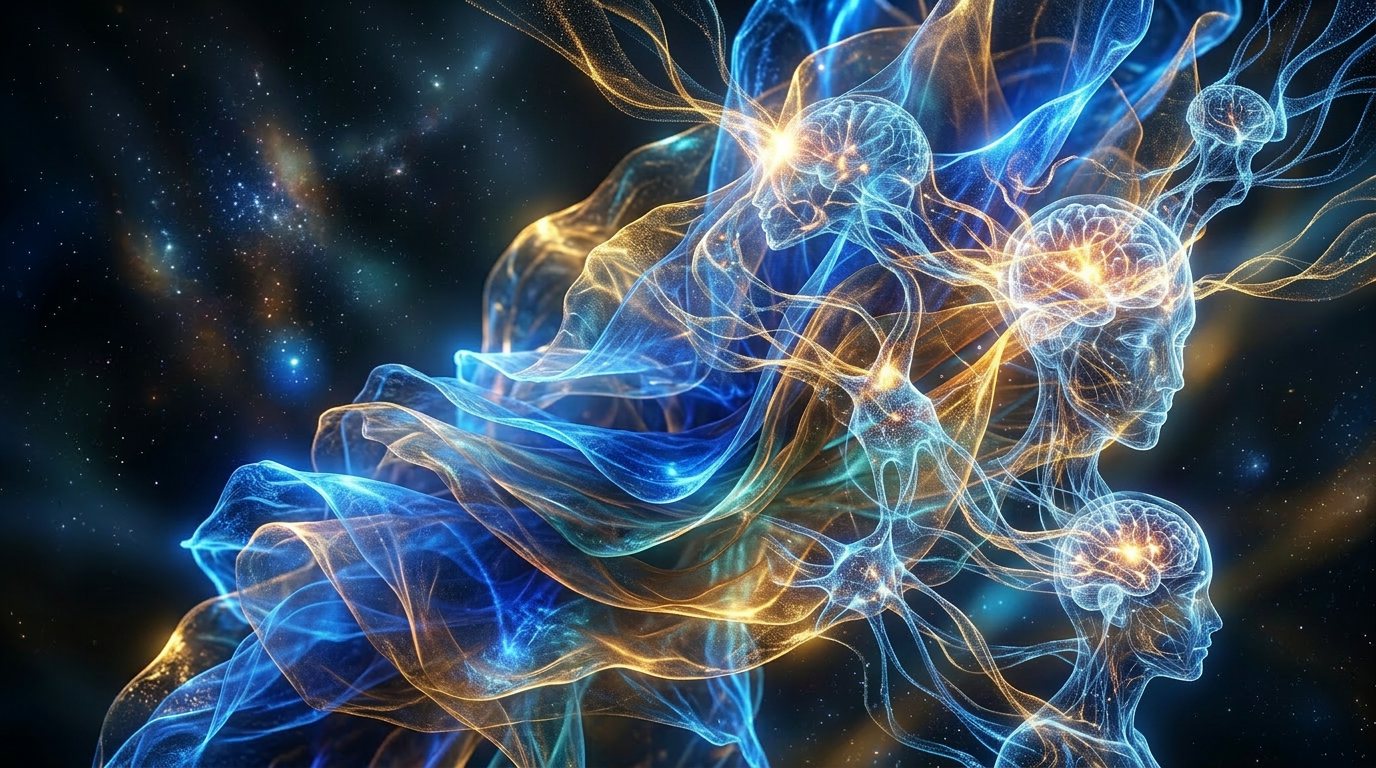
What do you think remains when the ego becomes silent?
The body?
The mind?
The personality?
Or something far deeper that was always present?
One of the deepest misunderstandings in spiritual inquiry is the fear that awakening destroys individuality. Human beings remain psychologically attached to their identities because identity creates continuity, familiarity, and the illusion of control. The mind assumes that if ego dissolves, existence itself will disappear. But from the perspective of deeper consciousness, realization does not destroy the functional individuality of a human being; it transforms the relationship between consciousness and identity. The body remains. Memory remains. Speech remains. Intelligence remains. The nervous system continues functioning. A realized being may still laugh, speak, teach, work, create, and respond to life. Externally, the structure appears similar. But internally, the mechanism of identification undergoes a profound shift.
Ordinarily, human beings do not merely use identity functionally; they become psychologically fused with it. Thoughts, emotions, achievements, failures, relationships, beliefs, roles, and even suffering become extensions of the self-image. The mind continuously reinforces the internal narrative of “I,” and over time this narrative becomes so dominant that pure awareness becomes buried beneath conditioning. The person no longer experiences life directly. Life is filtered through accumulated memory, emotional residue, fear, comparison, attachment, and unconscious psychological reinforcement. In this state, the ego is not simply arrogance. Ego is the compulsive identification with the constructed self.
As awareness deepens, observation begins separating itself from psychological involvement. This is a critical transition in inner evolution. Consciousness starts recognizing thoughts without becoming trapped inside them. Emotions arise, but there is space around them. Pain may still occur, but psychological suffering begins reducing because the identity feeding the suffering weakens. One slowly realizes that awareness itself exists prior to thought, prior to personality, prior even to the sense of “me” constructed by memory and experience.

Ancient masters attempted to explain this through symbolic analogies because ordinary language becomes insufficient beyond a certain depth of experience. One such analogy is that of a snake shedding its skin. The discarded skin still carries the form, shape, and visual appearance of the snake, yet the life that once occupied it has moved beyond it. Similarly, after deeper realization, individuality may continue appearing externally, but the inner psychological ownership over that individuality begins dissolving. The structure remains, but the compulsive attachment to the structure weakens.
This transformation is subtle and often misunderstood. Realization does not necessarily produce dramatic outer changes. The shift occurs primarily in the quality of consciousness itself. Reaction decreases because there is less egoic friction. Fear reduces because identity no longer feels constantly threatened. Emotional turbulence begins settling because the mind is no longer continuously defending an imaginary center. The need for validation weakens. Comparison loses intensity. Silence becomes natural rather than uncomfortable. One starts functioning with greater clarity because perception is less distorted by unconscious identification.
From a spiritual-scientific perspective, awakening can be understood as the progressive reduction of psychological entanglement. Consciousness becomes less localized around the constructed self-image and more expansive in observation. The organism continues functioning, but awareness no longer experiences itself as limited exclusively to the personality structure. This produces a very different quality of existence. Action still happens, but with less internal conflict. Intelligence becomes more direct. Presence becomes more stable. One begins responding to reality rather than merely reacting from conditioned memory.
In deeper states, individuality becomes functional instead of psychological. The person uses identity when necessary, but does not remain imprisoned within it. Like wearing clothing without believing the clothing defines existence, the realized being uses personality without deriving ultimate identity from it. This creates immense inner freedom because life is no longer experienced through constant self-preservation.
Perhaps this is why truly awakened beings often appear simpler than expected. There is less psychological noise within them. Less performance. Less compulsion to prove. Less fragmentation. Their presence carries a certain stillness because consciousness is no longer excessively occupied maintaining the illusion of separateness.
The final realization is not that individuality vanishes, but that individuality was never the ultimate truth of existence. It was only a temporary configuration through which consciousness experienced itself. When this becomes experiential rather than intellectual, life continues outwardly, yet inwardly something fundamental becomes silent, spacious, and free.
— Adi Maitreya
#AdiMaitreya #Consciousness #Awakening #SelfRealization #SpiritualScience #InnerFreedom #Meditation #Awareness #Mindfulness #HigherConsciousness #Ego #Enlightenment #SelfDiscovery #Presence #Transformation #Wisdom #Spirituality #HumanPotential #Observation #InnerAwakening #LifeBeyondMind #ConsciousLiving #Reality #Mysticism #KnowThyself #VijnanaBhairava #RaalSpandana #RaalParampara #MeditativeLiving #PathOfAwareness

