

We are surrounded by noise throughout our lives. Jap, Japa, or Japam is the science that guides a person deeper into one’s self. It allows connection to the soul’s whisper. It is the rhythmic, intentional repetition of a sacred word or phrase—a mantra. This practice bridges the finite with the Infinite. It connects the mind with the Divine and the breath with boundless stillness.
Japa, the root word in Sanskrit is “jap” (to mutter, to repeat silently), is far more than a technique. It is a practice, a prayer, a presence. It is where sound becomes silence and repetition becomes realization.
Japa in itself is not easy. It flows in different directions and dimensions. These were discovered by the rishis, yogis, and awakened mystics for the millennia.
1. Vaikhari Japa – The Spoken Stream
This is the most gross and accessible form of japa which a beginner can use. In this process the mantra is spoken out loud, clearly and audibly. It is the first rung of the ladder for beginners and those who find the mind wandering too much.
Purpose:
- Establish rhythm
- Anchor breath and focus
- Create sound vibrations in the body and surroundings
Use it when: you’re just starting, or when your inner storm needs a firm anchor.
2. Upamsu Japa – The Whisper of the Soul
This is an intermediate level; the lips move, and the tongue flickers. The sound is only barely audible. It is a secret shared between you and the cosmos.
Purpose:
- Draw the senses inward
- Calm mental chatter
- Strengthen subtle awareness
Use it when: you’re ready to shift from performance to presence.
3. Manasika Japa – The Silent Pulse
The most refined of the outer forms. This is mental japa—silent, internal, invisible. The lips don’t move. The tongue rests. The breath becomes subtle. The mantra resonates in consciousness alone.
Purpose:
- Sharpen concentration
- Refine ego
- Touch the formless
Use it when: you’re ready to feel the mantra as your own being, not just something you say.
4. Likhita Japa – The Sacred Script
Here, the mantra is written again and again, a fusion of jnana (knowledge), bhakti (devotion), and karma (action). The hand becomes a scribe of the soul.
Purpose:
- Combine mindfulness with devotion
- Create tangible focus
- Soothe the anxious or scattered mind
Use it when: you want to feel your intention flow through body, mind, and ink.
5. Ajapa Japa – The Unbidden Chant
This form of japam is quite difficult and it is considered the crown jewel of the japam. Here, japa becomes so deeply embedded that it continues without effort—even in sleep, even in breath. Ajapa means “non-recitation,” because you’re no longer the doer—the japa is happening through you.
Purpose:
- Merge with the mantra
- Become the vibration
- Experience union (yoga)
Use it when: it uses you. This isn’t practiced; it is received.
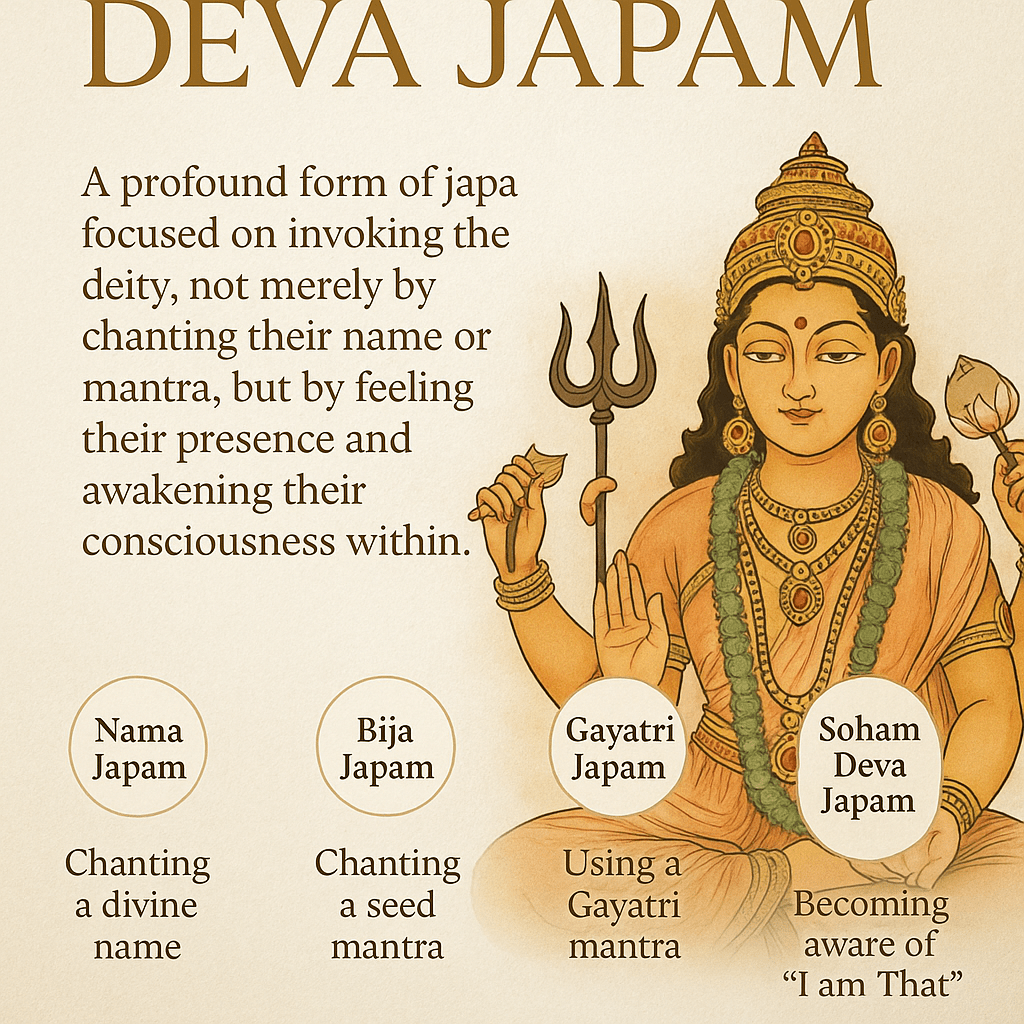
6. Deva Japam– Illuminating star
Deva Japam literally means “the divine repetition” or “chanting to invoke the Deva (divine being). But one needs to understand that one should become the Deva to Chant Deva Japam.
Chanting as the Deva, not to the Deva.
For attaining this level, the Sadhaka is transformed into the very embodiment of the mantra’s deity. In such a chant, you are not just calling Shiva, Durga, Narayana, or any tantric deities. You are awakening their consciousness within your being.
It’s a quantum leap from bhakta (devotee) to devata-swarupa (form of the divine).
The Core of Deva Japam:
- Unity through repetition: Repeating the name of the deity until the ego dissolves, and the inner deity awakens.
- Bhava (feeling) + Mantra (sound) + Dhyana (visualization) + Chaitanya (conscious presence) = Deva Japam.
Signs You’re Tapping Into Deva Japam:
- You feel waves of bhakti, joy, or tears
- Time vanishes—you’re in meditative absorption (samadhi-like)
- The mantra starts chanting you
- A sense of oneness with the deity’s qualities
- You carry the mantra’s vibration all day—even in silence
Deva Japam is not for show. It’s not performance—it’s presence. It’s a direct line to the divine within, bypassing ritual and dogma.
It is you saying: “I remember who I am. I am That. I am Deva.” And the universe?
It chants back in silence.
Why Do Japa?
Because the mind is a monkey.
Because the breath is a bridge.
Because words are wands, and mantras are spells that undo delusion.
Whenever one chants, one reclaims rhythm. You reclaim the sacred. Japa doesn’t just calm the mind—it tunes it. Each repetition chips away at karmic residue, clears psychic clutter, and refines your field. Done consistently, japa invokes shakti, awakens chitta, and pierces the veils of maya. A Mantra is Not Just a Word. It’s a living entity, a seed (bija) encoded with divine intelligence. It must be approached with reverence, not like a password, but like a prayer. With every repetition, you water this seed. Eventually, it blooms—not in the world, but in you.
How to Start Your Japa Practice:
- Choose a mantra (with guidance or from your heart): Do not choose one from the Internet. The mantra should be given by a Guru. If one hasn’t had a Guru, then start with a simple mantra
- Set a fixed time : Traditionally Brahma Muhurta—Nearly one and a half hours before sunrise was selected. It can be the time of your comfort, but afternoons and later nights are not preferred.
- Use a mala : The beads also has relevance. It is preferred to sandalwood, rosewood, Tulsi, and five mukhi rudraksha. The number of beads should be 108 beads to guide and ground)
- Stay consistent: Every day in the beginning, go for 11 chants, slowly raise to 21, then 51, then 108. Once a person has reached 108, one should try to do 10 mala rounds of 108. One should focus on the connection of each chant, remember it is not quantity but it is quality which matters. When the mantra drops from the lips to the mind, and then from the mind to the heart, transformation begins.
- Stay attentive during the chanting and make sure the mantra doesn’t ripple through you.
“Repeat the mantra until you disappear, and only the mantra remains. Then, let the mantra disappear too. What’s left is the Truth.”
~ Sri Adi Maitreya Rudrabhayananda ji (Sri AMaRa ji)
Soul Searchers intends to raise the consciousness of 20 million people. It aims to help create a turning point on this planet. It envisions a world where people are in tune with their inner selves. They will live healthy and creative lives. They will no longer be swayed by religious dogma or politics. The purpose is to restore the state of righteousness (dharma). This is crucial in the current state of political turmoil. It also addresses selfishly motivated people. We believe the truth can be known and realized through guided and workable ways.
#Maitrya #Adimaitreya #Diksha #64kalas #Awakening #Parampara #Lineage #maitreyaschoolofwisdom #मैत्रेयस्कूलऑफविज़डम #Guru #agoramaitreya #मैडिटेटिंगविथमैत्रेया #रुद्राभयानंद #Rudrabhayananda #मैत्रेय #ucsrd #ecology #Environment #Japa #Mantra
 Maitreya Wisdom