

Embarking on the journey of tracing one’s ancestry often invites visions of a simple path winding through time. It suggests a neat, linear connection. This connects us to our parents, grandparents, and generations long past. However, as one immerses deeper into this intricate genealogical tapestry, an enigma appears. It reveals a complex interplay of mathematics and biology. This challenges our understanding of identity, heredity, and the very essence of human existence. This intriguing puzzle is called the Ancestor Paradox. It pulsates with the rhythms of genetics, history, and the whims of chance.
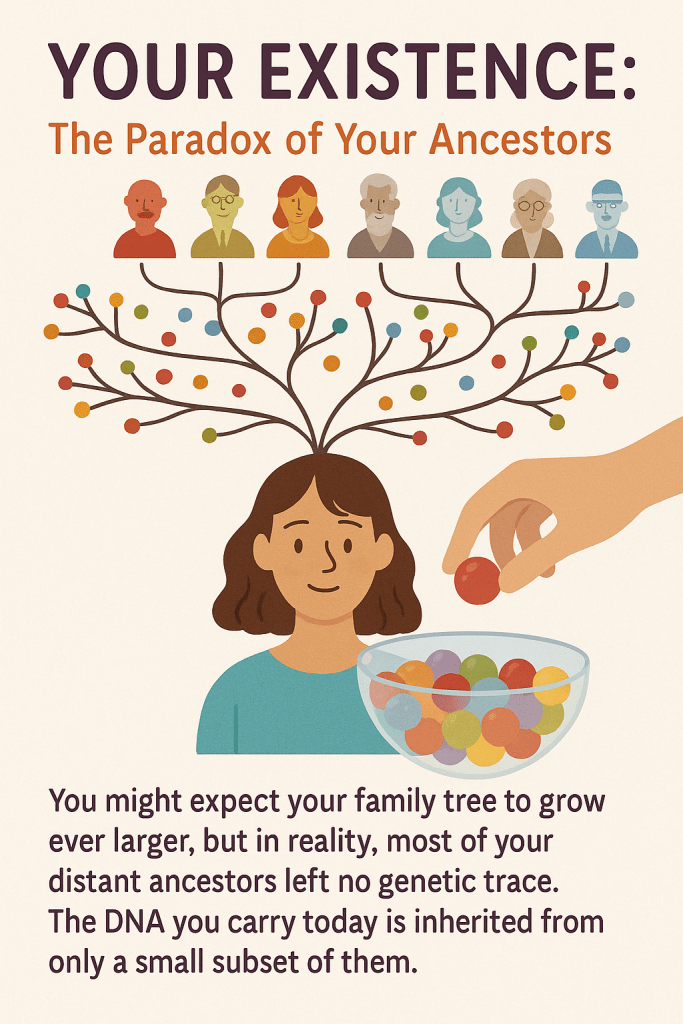
The Mathematical Mirage: At first glance, the math seems flawless. It is a perfectly structured tableau where each generation appears to double the number of ancestors. Two parents yield four grandparents, who in turn generate eight great-grandparents, and so on. Venture backward just 37 generations. This covers roughly 1,000 years. Mathematical logic unveils an astounding 137 billion ancestors in that singular moment of lineage. Yet this figure dwarfs the estimated 117 billion humans who have ever walked the Earth. How could this be?
The revelation lies in the phenomenon of pedigree collapse, an intricate web where ancestral lines entwine through intermarriage. Picture this: if your parents were cousins, they share the same grandparents. This effectively reduces the pool of unique ancestors in that generation. Historically, such familial overlaps were commonplace, particularly among royal dynasties eager to unify power. Think of the brilliant Albert Einstein. He married his cousin. Consider the contemporary prevalence of cousin marriage in regions of South India. It is on the decline. Similarly, cousin marriage are accepted in the Middle East, and sub-Saharan African populations either prefer or accept cousin marriages. In these areas, small, insular communities yield limited genetic diversity. Over millennia, these overlaps forged “loops” in family trees. They crafted a rich tapestry of shared ancestry rather than an ever-expanding canopy of branches.
DNA’s Fragile Inheritance:
Beyond the realm of genealogy, another layer complicates this paradox: the fragile dance of biological inheritance. Not every ancestor bequeaths their DNA to your personal genetic blueprint. Imagine each parent as a bowl filled with various colourful candies. Every sweet morsel symbolizes strands of genetic material. These strands have been passed down through the ages. Upon your conception, you randomly select candies from each bowl—some ancestral “treats” are chosen, while others remain untouched. As the generations unfurl, this randomness dilutes the genetic legacy:
- 10 generations back: A robust 50% chance of inheriting DNA from a specific ancestor.
- 15 generations back: A mere 3% likelihood.
Thus, the majority of remote ancestors fade into oblivion within your genetic makeup. Instead, your existence emerges from a curated ensemble of ancestral voices—a “genetic council” whose murmurs influence your very biology. This explains the tantalizing mystery of why certain traits, such as eye color or susceptibility to diseases, may skip generations. These traits can also emerge unexpectedly in those who seem most distant from the traits’ origins.
Historical Echoes:
Humanity’s nomadic past, coupled with its societal structures, intricately shaped this paradox. For millennia, populations remained small and often geographically isolated. Marriages within clans or tribes served pragmatic purposes—tethering survival to cultural continuity. These customs, while promoting pedigree collapse, also safeguarded cherished traditions and timeless knowledge. Yet, they introduced genetic bottlenecks, magnifying certain traits and vulnerabilities. The tragic legacy of hemophilia among European royalty highlights the dangers of shared ancestry. Hereditary disorders in isolated communities show how shared ancestry can be both a benefit and a burden.
Chance, Choice, and Legacy
The Ancestor Paradox does not detract from individuality; rather, it deepens it. You are not merely a mathematical anomaly but rather a convergence of innumerable choices and serendipitous accidents. The survival of each ancestor—navigating through plagues, seismic migrations, or devastating wars—carved a crucial path to your very being. Their intertwining stories of love, resilience, and relentless struggle are woven into the fabric of your DNA. These stories are also interwoven into your collective cultural memory.
Biologically, you become a mosaic, a vivid patchwork from a minuscule fraction of your lineage. Yet, culturally and historically, you embody the culmination of millennia of human experiences. This duality—the fleeting nature of genetics versus the profound depth of history—defines the paradox itself. Geneticist Adam Rutherford eloquently observes, “You are not just the product of your ancestors. You are the heir to a grand, chaotic symphony of life.”
Modern Identity: A Shared Tapestry
The paradox elegantly dismantles notions of racial or ethnic “purity.” Navigating through the intricacies of pedigree collapse and shared ancestry opens up a web of interconnection. This network binds us far more intricately than conventional narratives allow. Studies reveal that everyone of European descent shares common ancestors merely 600 years ago. Researchers conducted a groundbreaking exploration of mitochondrial DNA. This genetic heirloom is passed exclusively from mother to child. They unearthed a profound revelation: the majority of Indian mitochondrial lineages are deeply entrenched within the subcontinent. These lineages are ancient and distinctly unique. These maternal genetic tapestries show minimal intertwining with those of neighboring regions. They trace back to a common ancestor shared with populations outside South Asia from tens of thousands of years ago. This insight suggests that Indian maternal ancestry has remained remarkably insular. It has evolved in a cocoon of relative isolation. It is largely untouched by significant migrations from the west, east, or north.
In stark contrast, when scientists delved into the paternal genetic narrative, a markedly different story unfolded. The Y-chromosomes, carried from father to son, revealed a closer genetic kinship with populations across West Eurasia. This encompasses Europeans, Central Asians, and those from the Near East. This pattern presents clear evidence of male-mediated admixture. It hints at waves of groups incoming from the northwest. These groups left lingering traces on the paternal lineage.
Some historians have chosen to step back. They are confronted with this striking dichotomy—an enduring maternal lineage juxtaposed against a more intricate paternal tale. They perceive the data as too discordant to harmonize. To further complicate matters, many geneticists are not well-versed in archaeology, linguistics, and cultural anthropology. They have occasionally fumbled in their interpretations of ancient human narratives. They often succumb to hasty conclusions or fall into well-known scholarly pitfalls.
Nevertheless, to dismiss genetics as merely a side note would be a grave oversight. Geneticists may appear as the late-arriving “barbarians” at the gates of historical inquiry. They wield a revolutionary tool: data unlike any that has ever been available before. The genome is devoid of opinion. It is an unerring witness that retains a record of human journeys, unions, isolations, and upheavals. These are clues to ancestral truths previously obscured by layers of myth, migration, and memory. Whether these revelations are embraced or resisted, they are profoundly reshaping our understanding of identity. They are reshaping the tapestry of our origins. Across the globe, populations have entwined through the tapestry of millennia. This profound interconnectedness underscores the folly of divisive ideologies that rest on superficial differences.
The Ancestor Paradox lays bare the fragile beauty of existence. You are neither the product of billions nor a mere outcome of a linear fate. Instead, you are a singular note in an ancient, harmonious melody. You are sculpted by chance, history, and the indomitable spirit to survive. In a universe governed by entropy, your existence is a defiant miracle—a testament to the convergence of countless lives. Through the silent language of DNA, you carry pass along the legacy of those who came before. You also do this through the echoes of stories long forgotten. In this sense, the paradox is not a puzzle to resolve. It is a truth to embrace. You are fleeting yet eternal. You are unique yet universal—a living testament to life’s infinite and wondrous complexity.
~ Sri Adi Maitreya Rudrabhayananda ji (Sri AMaRa ji)
Soul Searchers intends to raise the consciousness of 20 million people. It aims to help create a turning point on this planet. It envisions a world where people are in tune with their inner selves. They will live healthy and creative lives. They will no longer be swayed by religious dogma or politics. The purpose is to restore the state of righteousness (dharma). This is crucial in the current state of political turmoil. It also addresses selfishly motivated people. We believe the truth can be known and realized through guided and workable ways.
#Maitreya #Adimaitreya #Diksha #DNAParadox #Awakening #Parampara #Lineage #maitreyaschoolofwisdom #मैत्रेयस्कूलऑफविज़डम #Guru #agoramaitreya #मैडिटेटिंगविथमैत्रेया #रुद्राभयानंद #Rudrabhayananda #मैत्रेय #ucsrd #ecology #Environment #CleanHandsSacredHands #GemstoneWisdom #SpiritualStyleWithSense
 Maitreya Wisdom